Technical Heating Service

Boiler Repair & Heating Service

Specialized hydronic diagnostic service, zone valve replacement, circulator pump repairs, and baseboard radiator heating maintenance for residential boilers.
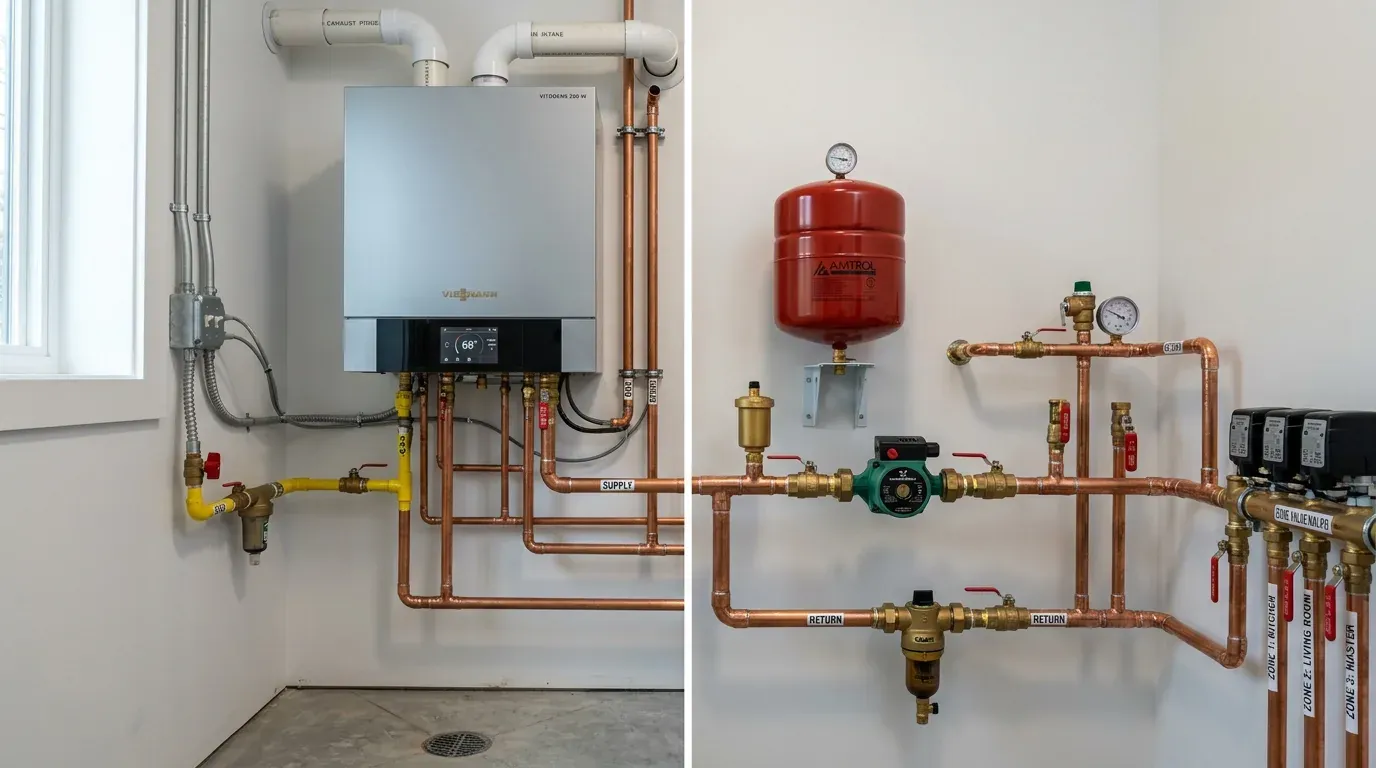
Boiler Repair & Heating Service - Professional diagnostic inspection and equipment service
Diagnostic Support

Detailed Service Overview

Hydronic and radiant heating systems offer quiet, comfortable warmth, but troubleshooting closed-loop water systems requires specialized technical knowledge. When baseboard radiators remain cold, system pressure gauges spike erratically, or the pressure relief valve discharges water across your floor, our technicians quickly isolate the failure. We troubleshoot waterlogged expansion tanks, replace seized circulator pumps, bleed stubborn air pockets from secondary loops, and replace failed motorized zone valves. From vintage cast-iron sectional steam boilers to modern modulating-condensing wall-hung units, we restore balanced hydronic circulation and calibrate aquastat temperature settings for safe, steady radiant heat.

Common Heating Symptoms Requiring Attention

  • Observed Issue: Baseboard radiators or in-floor radiant loops remain completely cold.
  • Observed Issue: Pressure relief valve frequently drips or dumps water onto basement floor.
  • Observed Issue: Loud clanking, knocking, or pipe whistling sounds throughout home.
  • Observed Issue: Boiler pressure gauge reads above 30 PSI or below 10 PSI.
  • Observed Issue: Water leaks around circulator pump flanges or expansion tank.

Diagnostic Procedures & Technical Standards

  • Technical Protocol: Hydronic loop air purging and radiator bleed valve servicing.
  • Technical Protocol: Diagnosis and replacement of seized wet-rotor circulator pumps.
  • Technical Protocol: Diaphragm expansion tank pressure testing and tank replacements.
  • Technical Protocol: Motorized zone valve troubleshooting and thermostat wiring repairs.
  • Technical Protocol: Digital combustion testing on cast-iron and condensing hydronic boilers.

Need Immediate Troubleshooting For Boiler Repair & Heating Service?

Heating dispatchers are available to review equipment symptoms, check service coverage in your zip code, and dispatch diagnostic assistance.

Call Dispatch: 877-729-2205

Frequently Asked Questions: Boiler Repair & Heating Service

Uneven baseboard radiator heating usually indicates trapped air pockets blocking hot water circulation or a defective motorized zone valve stuck closed. Technicians bleed air from individual radiator valves or purge zone manifolds to restore balanced hydronic flow.
A discharging thirty-PSI relief valve indicates either excessive internal water pressure or a waterlogged expansion tank. Failed internal rubber bladders in expansion tanks prevent expanding heated water from cushioning, spiking boiler pressure and forcing safety valves open.
Technicians check voltage at the circulator terminal box and use magnetic rotation indicators or touch thermography to verify impeller spinning. Seized impellers hum loudly and overheat without moving heated water through the supply manifolds.
Hot water hydronic boilers heat closed loops of water to around 180 degrees Fahrenheit and circulate it using electric pumps. Steam boilers boil water to 212 degrees Fahrenheit, generating low-pressure steam that rises naturally through pipes to radiators without requiring circulating pumps.
Steam boilers lose minute amounts of water through air vents during operation and require adequate water levels to submerge the cast-iron heat exchanger. Low-water cutoff safety controls immediately shut off burners if water falls below safe levels, preventing catastrophic heat exchanger cracking.
Loud knocking sounds—often referred to as water hammer—occur when steam bubbles collapse inside water lines or when pipe hangers are fastened too tightly, preventing thermal expansion. Air trapped inside pipe loops and failing circulators also generate pipe rattles.
Hydronic and steam boilers require thorough annual inspection before each heating season. Technicians clean flue collector passes, test the backflow preventer and pressure reducing valve, test the aquastat high-limit control, and verify burner combustion efficiency.
Soot accumulation indicates incomplete fuel combustion caused by restricted draft venting, low gas supply pressure, or dirty burner orifices. Soot insulates the cast-iron boiler sections from heat transfer, dramatically driving up fuel consumption and generating toxic carbon monoxide.

Request Boiler Repair & Heating Service

Speak with our technical dispatch team for prompt diagnostic scheduling and itemized heating repair estimates.

877-729-2205

Quick Diagnostic Request

Boiler Repair & Heating Service Specialists

Schedule Precision Heating Diagnostics Today

Do not let minor heating glitches turn into frozen pipes or total winter breakdowns. Speak with our dispatchers for clear pricing and prompt technical scheduling.